
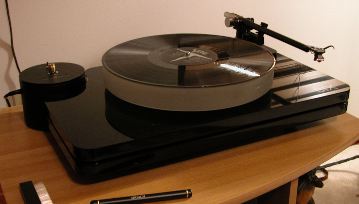
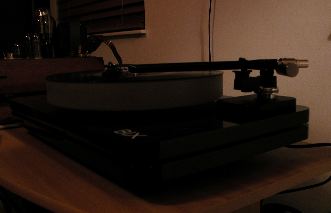
From the defunct web page: DC motor from Belgium with advanced motor controller, crowned pulley that can use round, flat, thread, or tape belt (comes with 2 x nylon thread-belts), switchable 33/45 rpm, motor pod separate from plinth. Precision inverted bearing mounted on the same plane as playing surface and drive pulley, highly polished ceramic ball on Teflon thrust plate, lubrication through hollow spindle, 40mm thick acrylic platter adjustable height. Solid aluminum armboard for rigid 4 point mounting, supplied with 3 boards for SME, standard Rega and Morch. Plinth is 2-section American acrylic, three point mounting provides some decoupling as adjustable feet are attached to bottom section while arm/bearing attached to bottom section while arm/bearing attached to top. An full kit parts image is also available.
|
|
|
Michell after-market VTA adjustor, knurled nut and techno-weight are a huge improvement in sound and convenience over the stock RB-250. Using the "thicker" supplied base for the Rega tonearm, The VTA adjustor however raised the arm slightly higher than the acrylic platter. This required adding a washer to the base of the spindle, thus raising the platter.
Runout on this table is approximately .005" using a micrometer. Not sure what is "normal" runout, but I was impressed. Not what I want in my table-saw, but not bad for a turntable.
I implemented Brian's suggestion on how to minimize the sound of the DC motor using blutac. I further dampened the internal housing with automobile dampening material obtained from parts express. This modification did indeed lower the sound, but it's no where near dead quiet. Turns out this in part has to do with the belt one uses as well... see next point.
A request / plea for belt information over at the DiyHIFI Audio forum yielded a generous donation from Santosh (thanks!) who sent me a small role of polyester MONO FILAMENT line used in textiles spinning/weaving companies. It's tough to tie off, but the improvement in using this is impressive. The motor is much quieter, and minimal-to-no belt slippage resulting in holding the speed better than before.
The previous owner used a rubber? Michell turntable belt. This left a nasty streak on the acrylic that was extremely problematic to get off. Turns out using an eraser did wonders for removing this streak, and with a little elbow grease got rid of 95% of the streak. Short suggestion, however... don't use rubber belts on this table.
Spindle noise was a bit of a problem when I started experimenting with various different oils. Cleaning the bearings, and re-oiling them with the original oil shipped from the factory got them back to dead silent.
I find I'm liking this table far more than I thought I would. While it was a leap of faith, I've determined the Bix flat out rocks. It looks good and sounds great. If the "new" Bix Brian is about to ship, performs anywhere near the "classic" version, it's quite a bargain.
The mini hex inset screws for managing VTA on the arm-board should never be used as they provide the perfect way to screw up the tone-arm threads. Shims (while more painful to install) I found are a temporary stop-gap until I can get one of the 'on the fly' VTA adjustors (VTAF, Teres). An after-market VTA tool seems like a must. For the RB-250, I think this table would benefit from a counterweight as well.
The bottom plinth requires about an 1/8" more clearance to allow better sitting of the supplied Rega tone-arm washer / nut.
Daycron braided 30lb fishing line makes a good belt with minimal slippage.
The DC motor is relatively loud (e.g. not dead quiet). Brian has made a suggestion on how to use blutac to minimize the sound but I haven't tried this yet.
The two plinth sections are joined by three plastic? discs as spacers. The unit has three feet on it's base plinth and the spacers and feet are installed so that they are evenly spaced as opposed to being directly coupled. Exploring alternative kinds of spacers may be worth considering.
Eric Miller